
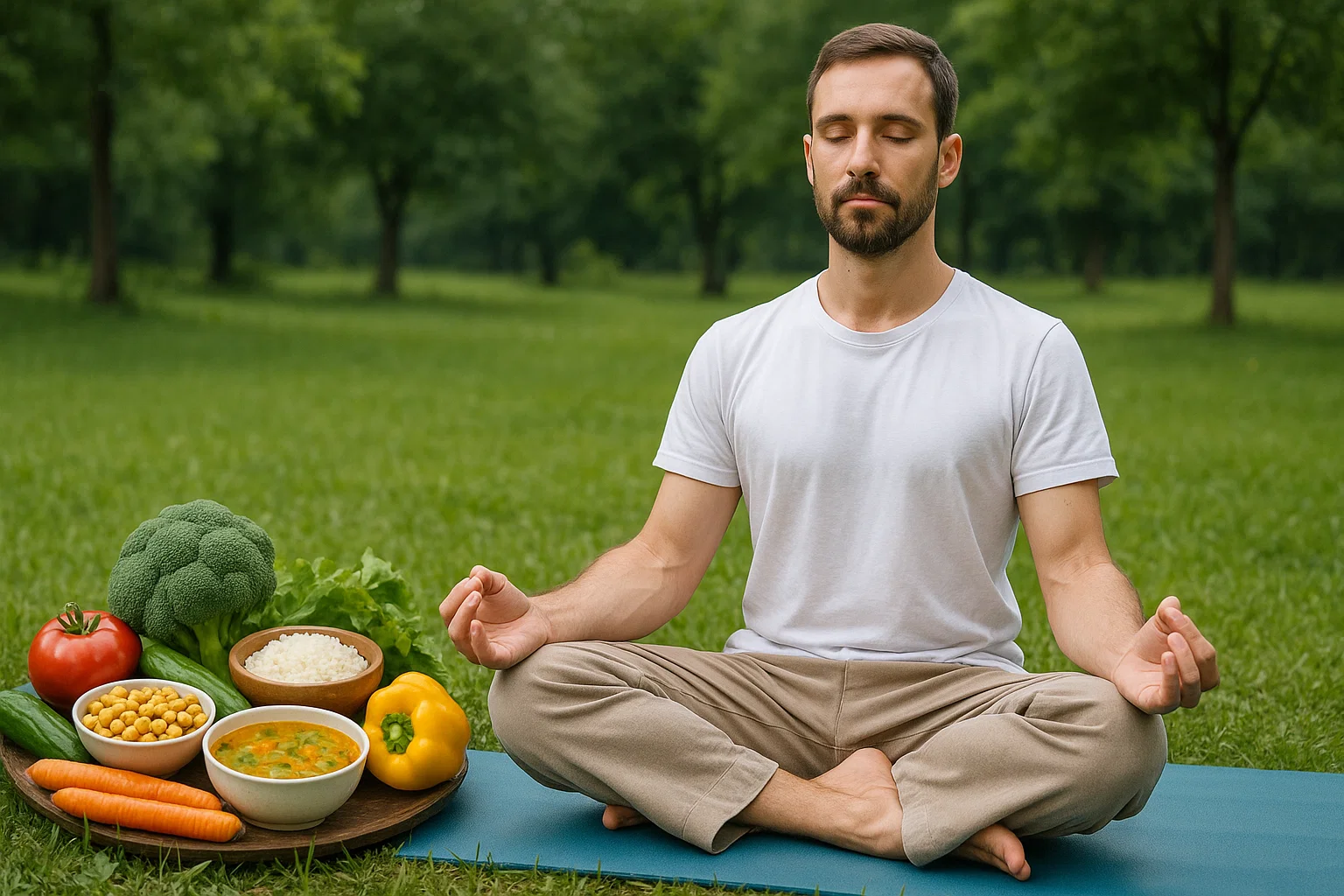
Why You Can’t Meditate: Poor Diet, Sleep, and Lifestyle Habits Are to Blame
Have you ever sat down to meditate—ready, focused, and excited—only to find your thoughts racing, your body fidgety, or your energy dull? You’re not alone.
The problem might not be your practice. It might be your lifestyle habits inner environment.
As yoga instructors and teachers, we often talk about stillness, awareness, and being present. But what we sometimes forget is that meditation doesn’t start when we close our eyes. It starts much earlier—with what we eat, how we sleep, and the way we live.
And that’s what makes our online meditation course different. It doesn’t just guide you into silence—it prepares your whole being to enter it.
Let’s dive into why creating the right inner environment is essential—and how diet, sleep, and lifestyle can either support or sabotage your meditation journey.
1. Meditation Needs a Prepared Body—And That Starts with Diet
You can’t meditate deeply if your body is inflamed, bloated, or craving sugar.
We’ve all had those days when a heavy meal made us feel sleepy or a sugar crash made us restless. As a yoga teacher or aspiring meditation instructor, you must understand that diet shapes your energy, and your energy shapes your meditative state.
✅ What the Yogic Diet Teaches:
- Sattvic foods (light, natural, nourishing) promote clarity, peace, and stillness.
- Rajasic foods (spicy, stimulating, caffeinated) can increase restlessness and anxiety.
- Tamasic foods (processed, stale, heavy) dull the mind and promote inertia.
In our online meditation course, we dive deep into the yogic understanding of food—not just what to eat, but when, how, and why. It’s not about restriction, but alignment. When your gut is clean and your prana flows freely, meditation becomes natural.
2. If You’re Not Sleeping Right, You’re Not Meditating Deeply
Lack of quality sleep is one of the biggest invisible blocks for yoga teachers today. You’re teaching classes, planning sequences, managing students, and possibly even working another job. You end the day exhausted—but wired.
The result? You wake up groggy. You try to meditate but your brain feels foggy. You sit still but your nervous system is jittery.
Here’s the truth:
Meditation isn’t a replacement for sleep—it’s a partner to it.
In our online meditation course, we help yoga instructors assess their sleep cycles using yogic principles. Through pranayama, evening kriyas, and specific meditation techniques, we help reset your internal clock.
We even cover how melatonin, cortisol, and circadian rhythms tie into ancient wisdom—so you understand not just the what, but the why.
3. Lifestyle Habits: Your Everyday Choices Are Your Meditation Teachers
Let’s be honest—many yoga instructors feel overwhelmed by modern life. Scrolling Instagram for yoga inspo, rushing to classes, skipping meals, forgetting to breathe.
Sound familiar?
The truth is, you can’t meditate if your life is chaotic.
Meditation reflects life, and life shapes meditation.
That’s why our online meditation course pays special attention to lifestyle as sadhana (spiritual practice).
We look at:
- How you spend your mornings (Are you tuning inward—or reaching for your phone?)
- Your energy hygiene (Are you taking in too much from students or social media?)
- The pace of your day (Are you sprinting through, or moving with awareness?)
When you adjust your lifestyle, you start to notice something beautiful:
You don’t do meditation anymore. You live it.
4. Inner Environment: The Soil Where Meditation Grows
Imagine trying to grow a lotus in dirty, stagnant water. Impossible, right?
Meditation is that lotus. And your inner environment—made up of your diet, sleep, and daily rhythm—is the water.
As yoga instructors, it’s easy to get caught up in teaching others and neglecting our own space. But remember: You can only take students as deep as you’ve gone yourself.
Our online meditation course is crafted for teachers like you. It’s not a passive program of watching guided meditations—it’s a complete transformation of your inner terrain.
We help you:
- Clean the diet clutter
- Sync your lifestyle with yogic rhythms
- Reclaim sacred rest
- Cultivate a peaceful, receptive nervous system
Only then does true meditation blossom.
5. Teaching Meditation? Start Living It
If you’re a yoga teacher who dreams of guiding others into deeper awareness, you must begin by creating the space within yourself. Students don’t just follow your words—they feel your energy.
The teachers in our online meditation course often say:
“I came to learn how to teach meditation, but I ended up learning how to live it.”
You don’t need to sit in a cave or fast for 40 days. You need to start with small, powerful shifts in how you eat, sleep, and live.
Ready to Become a Meditation Guide?
Our online meditation course is perfect for yoga instructors, wellness coaches, or anyone who wants to integrate authentic, grounded meditation into their teaching. You’ll learn how to:
- Prepare the inner environment for effective meditation
- Use diet and pranayama as preparation tools
- Build consistent inner stillness, not just occasional silence
- Guide students with confidence and clarity
By the end of the program, meditation won’t be something you “do”—it will be something you are.
Last Thought: The Stillness You Seek Is Waiting
You’re already on the path.
Now it’s time to remove the blocks.
Fix the food.
Clean the sleep.
Slow the pace.
And let your inner environment become fertile soil for awareness.
Explore our online meditation course today—and start living the meditation you’ve always tried to teach.
